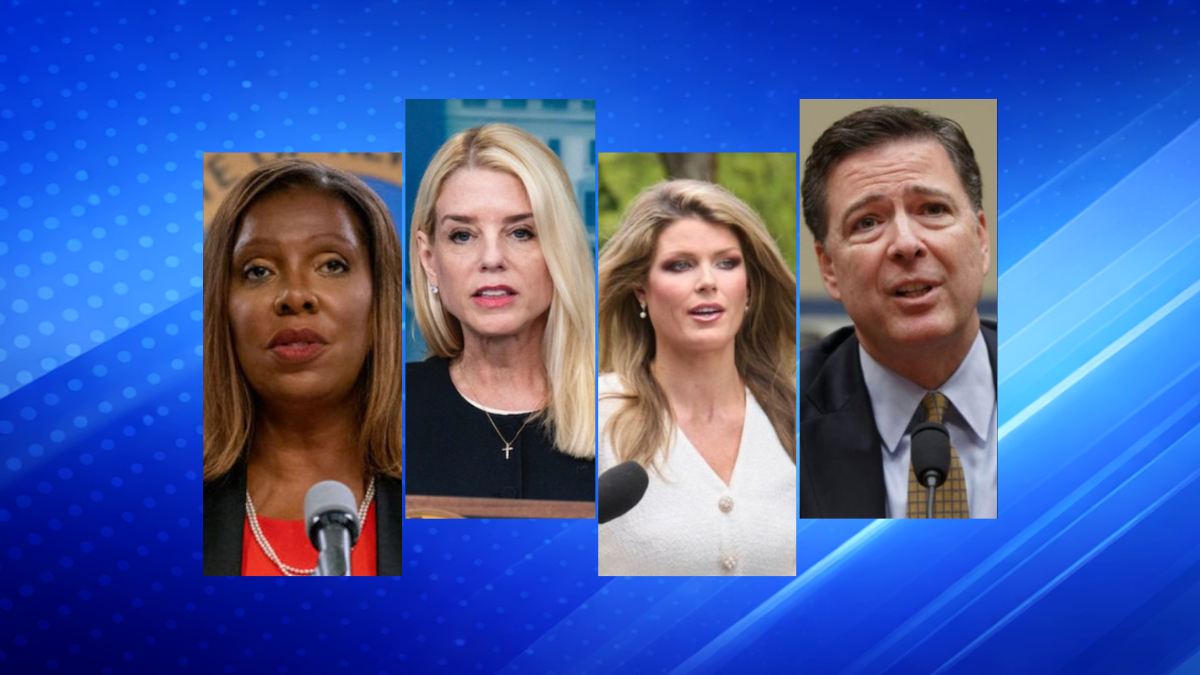
DOJ BRIEF, when a federal judge ruled that Lindsey Halligan was unlawfully appointed as interim U.S. attorney for the Eastern District of Virginia, it initially appeared to deal a fatal blow to the prosecutions of former FBI Director James Comey and New York Attorney General Letitia James. The Department of Justice now argues that the ruling was not decisive and that the indictments sought under former President Donald Trump’s administration should remain valid.
In a 47-page filing submitted to the 4th U.S. Circuit Court of Appeals, the Trump administration again defended Halligan’s appointment while also acknowledging that a three-judge panel could reach a different conclusion.

Under that alternative outcome, the court could agree that U.S. Attorney General Pam Bondi did not lawfully appoint Halligan, yet still determine that the indictments themselves remain valid.
Senior U.S. District Judge Cameron Currie dismissed Comey’s false statement case and James’ bank fraud prosecution in November, finding that Halligan acted without “lawful authority.” The DOJ contends that Currie’s decision went too far by, in its words, improperly applying “the strong medicine of dismissing indictments duly returned by two grand juries.”
Halligan continued in her role for more than a month following the ruling but drew scrutiny from another federal judge in January after she continued to identify herself as U.S. attorney on court filings.
U.S. District Judge David J. Novak, a Trump appointee, criticized Halligan’s actions, describing them as a “charade” in which she was “masquerading” as U.S. attorney and acting in what he characterized as defiance of binding court orders referencing Currie’s dismissals.
The DOJ responded by accusing Novak of conducting what it described as an “inquisition,” but Halligan ultimately stepped aside on Jan. 20 as judges in the Eastern District of Virginia began the process of selecting a replacement, including publicly advertising the position.
Despite Halligan’s departure, the DOJ maintains that Attorney General Bondi’s decision to retroactively ratify Halligan’s authority as both interim U.S. attorney and special attorney resolved what it characterizes as a “paperwork mistake” affecting the indictments, which Halligan alone signed.
According to the government’s filing, the alleged appointment error amounted to citing the wrong statute when authorizing Halligan to seek and obtain the indictments. Even if that amounted to legal error, the DOJ argues it did not prejudice the defendants and was later cured through multiple ratifying orders issued by the attorney general.
The DOJ further asserted that Halligan was, at a minimum, an attorney for the government when she presented the Comey and James cases to the grand juries and obtained the indictments.
The brief argues that even if the attorney general lacked authority to appoint Halligan as interim U.S. attorney, that did not mean she was unauthorized to seek or sign indictments on behalf of the United States, noting that such actions do not require holding the U.S. attorney title.
In its closing argument, the DOJ stated that neither Comey nor James demonstrated that concerns over Halligan’s appointment caused sufficient prejudice to justify dismissal of the cases.
The filing concludes that the grand juries’ decisions were not influenced by Halligan’s title and that it was not fundamentally unfair for her to present evidence in her role as interim U.S. attorney rather than in another authorized capacity.